
Rules
Boxing Rules for Beginners: Fouls, Counts and Scoring
Learn the boxing rules that decide a fight: legal targets, fouls, knockdown counts, gloves, rounds and scoring, with pro and amateur rules side by side.
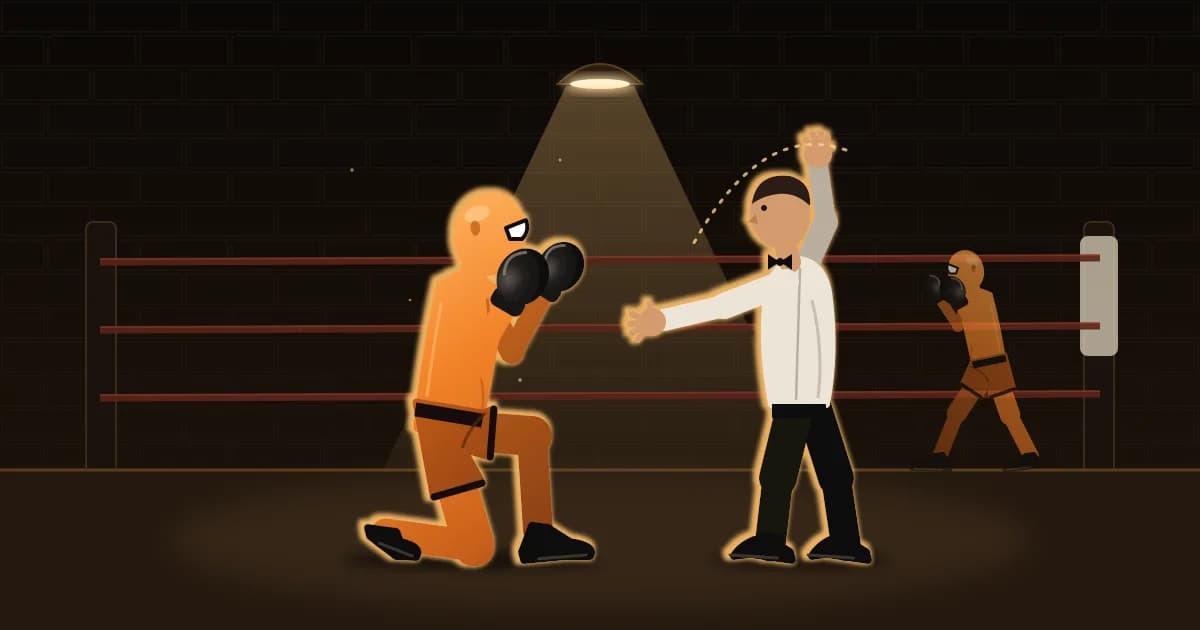
Boxing rules let you hit only with the padded knuckle part of a closed glove, only on the front and sides of your opponent's head and body above the belt. A referee punishes fouls, a boxer who goes down must beat a count of 10, three judges score every round on the 10-point must system, and the fight ends by knockout, stoppage, disqualification or the judges' decision.
Those basics go back to the Queensberry rules of 1867, the first code to demand gloves, three-minute rounds and a 10-second count. The details change with the fight in front of you. A professional bout in the US runs on its state commission's rules and the Unified Rules many commissions adopt. An amateur bout runs on World Boxing's rules internationally or USA Boxing's rules in the US. Below you get the target and the fouls drawn out, how knockdowns and counts work, the referee's three commands, every way to win, the gear and round rules, and a pro against amateur table.
Know which rulebook covers your fight
Professional boxing has no single world rulebook. In the US, each state's athletic commission licenses the boxers and sets the rules, and many adopt the Association of Boxing Commissions (ABC) Unified Rules for championship fights. The examples below come from the ABC Referee Guidelines, the Unified Championship Rules the Nevada Athletic Commission publishes, and the Nevada Rules of Unarmed Combat revised in November 2024.
Amateur boxing works from two books. The World Boxing Competition Rules, in force since November 2024, govern international amateur events. The USA Boxing National Rule Book, effective January 1, 2026, governs USA Boxing events, from local club shows to national championships.
Before your first bout, ask your coach or the event organizer which book applies. Gloves, rounds, headgear and counts all depend on it.
Hit only the legal target
The Nevada rules (rule 4.120) define a fair blow as one landed with the padded knuckle part of the glove on the front or side of the head, or the front or side of the body above the belt. World Boxing spells the target out in rule 7.2.2.3: the forehead, temples, cheeks, chin, the front of the ears to the jawline, the chest from the collarbone down, the ribs up to the armpits, and the stomach above the belt line. The back of the head, the neck, the throat, the spine, the lower back and everything below the belt sit outside it (rule 7.2.2.4).
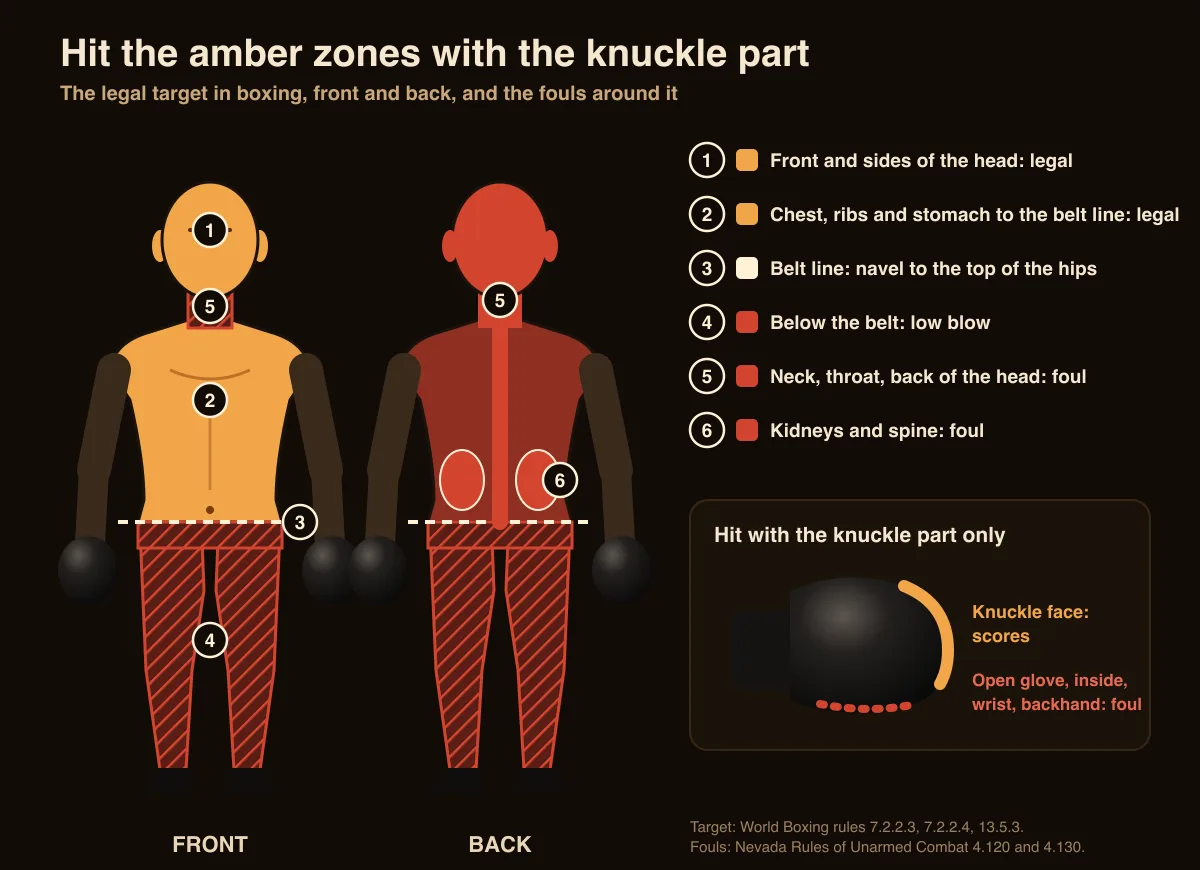
The belt line sits higher than most beginners think. World Boxing draws it as an imaginary line from the navel to the top of the hips (rule 13.5.3), and Nevada lists "hitting an opponent below the navel" as foul number one. A body shot that lands below the top of the hip bone is a low blow.
How you hit matters as much as where. The open glove, the inside of the glove, the wrist, the side of the hand and the backhand all count as fouls in both rulebooks. Learn the six legal punches by number in our boxing punches guide.
Avoid the fouls referees punish most
Nevada lists 32 fouls in rule 4.130 and World Boxing lists 35 in rule 8.5. The ABC Referee Guidelines tell referees to warn both boxers in the dressing room about the three most common and harmful: headbutting, low blows and holding. Expect to hear those three in your instructions before the first bell.
| Foul | What it means | Where you find it |
|---|---|---|
| Low blow | Any punch below the belt line | Nevada 4.130(1), World Boxing 8.5.1 |
| Headbutt | Striking with the head, also with the shoulder, forearm or elbow | Nevada 4.130(7), World Boxing 8.5.2 to 8.5.4 |
| Holding and hitting | Holding with one hand and punching with the other | Nevada 4.130(3), World Boxing 8.5.12 |
| Holding | Grabbing or keeping a clinch on purpose | Nevada 4.130(4), World Boxing 8.5.11 |
| Rabbit punch | A punch to the back of the head, the base of the skull or the back of the neck | Nevada 4.130(12), World Boxing 8.5.8 |
| Kidney punch | A deliberate punch to the back over the kidneys | Nevada 4.130(10), World Boxing 8.5.9 |
| Hitting on the break | Punching after the referee calls "Break" | Nevada 4.130(16), World Boxing 8.5.33 |
| Hitting after the bell | Punching once the bell ends the round | Nevada 4.130(17) |
| Hitting a downed boxer | Punching an opponent who is down or getting up | Nevada 4.130(2), World Boxing 8.5.28 |
| Ducking below the belt | Crouching so low that legal punches become low blows | Nevada 4.130(25), World Boxing 8.5.29 |
A few fouls surprise beginners. Spitting out your mouthpiece on purpose is a foul. So are pushing, using the ropes to punch, pivoting into a backhand, and in Nevada, timidity: avoiding contact, faking an injury or dropping the mouthpiece again and again.
Know what a foul costs you
In a professional fight, the referee decides whether a foul was accidental or intentional, and the ABC Referee Guidelines set the price. An intentional foul without injury costs one point. An intentional foul that injures your opponent costs two points, and that deduction is mandatory. If the injury ends the fight on the spot, the fouling boxer loses by disqualification. A referee can also disqualify a boxer who keeps fouling or keeps ignoring commands.
Low blows have their own rule. A boxer hit with an accidental low blow gets up to five minutes to recover, then must continue or lose by technical knockout. Nevada closes the loophole in rule 4.180: you cannot win a fight by claiming a low blow, and a boxer who refuses to continue after one loses by TKO.
Amateur referees work with cautions and warnings. Under World Boxing rule 8.11, every warning takes one point off your total on every judge's card, and a third warning in a bout disqualifies you.
Count a knockdown the way the referee does
A knockdown happens when a legal punch makes you touch the floor with anything other than your feet, leaves you hanging on the ropes, or sends you through or over them. The Nevada rules (4.270) set the routine:
- The referee sends your opponent to the farthest neutral corner and starts counting out loud, one number per second, with an arm signal.
- If your opponent leaves the corner, the count stops until they go back.
- You cannot fight on until the referee reaches 8, even if you are up at 2. That is the mandatory eight count.
- If you are still down at 10, you lose by knockout.
The Unified Championship Rules add the details fans argue about. There is no standing eight count and no three-knockdown rule, so a referee can let a pro fight on after a third knockdown in a round or stop it after the first. The bell never saves a downed boxer, in any round. Knocked through the ropes onto the apron, you get 10 seconds to stand up and climb back in. Knocked clear of the ring, you get 20 seconds, and help from your corner can get you disqualified. If both boxers go down together and both stay down through 10, the fight ends as a technical draw.
Amateur rules differ in one big way. World Boxing (rule 8.6.1) lets a referee give a standing eight count to a boxer who took a hard punch and looks hurt without falling, and that count scores as a knockdown. The rules cap it at three eight counts in one round and four in one bout (rule 8.7.1), and a boxer who cannot box on after an eight count loses by referee stopping the contest (rule 9.2.2). USA Boxing uses the same limits in rule 19.6. Judges then weigh knockdowns inside the round, as our guide to how boxing is scored explains.
Follow the referee's three commands
The referee is the only person who can stop a professional fight (Unified Championship Rules, rule 3). Three words run every bout. World Boxing lists them in rule 8.1.1, plus "Time" for stopping the clock:
- "Stop" means stop boxing right now.
- "Box" means start or go on boxing.
- "Break" means let go of the clinch and step back before you punch again.
A punch that lands at the same moment as "Break", "Stop" or the bell counts as legal under the ABC guidelines. A punch that lands after it is a foul. Practice the break in sparring: when your coach calls it, take a full step back with your hands up.
Win the fight one of these ways
| Result | How it happens |
|---|---|
| Knockout (KO) | The downed boxer fails to beat the 10 count |
| Technical knockout (TKO) | The referee stops the fight because a boxer cannot defend or go on, or a legal punch causes an injury that ends it |
| Disqualification (DQ) | An intentional foul injures the opponent so badly the fight ends, or a boxer keeps fouling or ignoring the referee |
| Decision | The fight goes the distance and the judges' cards decide it: unanimous, split or majority |
| Technical decision | An accidental foul ends the fight after four complete rounds, and the boxer ahead on the cards wins |
| No decision | An accidental foul ends the fight before four complete rounds |
| Draw | The cards come out level, or a technical draw after a double knockdown or a later intentional foul injury |
The four-round rule in the ABC guidelines (section 34) decides most of the strange endings. An accidental headbutt that cuts a boxer too badly to go on in round 3 gives you a no decision. The same cut in round 6 sends everyone to the scorecards, and the judges score the partial round.
Score the rounds on the 10-point must
Three judges score every professional round on their own. The winner of the round gets 10 and the loser 9 or fewer, a knockdown usually costs one extra point, and the ABC guidelines say a round never drops below 10-6 unless the referee deducts points. At the final bell, each judge adds their card, and the boxer ahead on most cards wins. World Boxing bouts use five judges who must pick a winner of every round.
Our full guide to how boxing is scored walks through every decision name with worked cards, and you can score a fight round by round on the boxing scorecard.
Check the rounds, gloves and gear for your level
| Rule | Professional (ABC, Nevada) | World Boxing amateur | USA Boxing amateur |
|---|---|---|---|
| Rounds | 10 or 12 for a title, 3 minutes each (women 2 minutes) | 3 rounds of 3 minutes (U17: 2 minutes) | 3 rounds of 3 minutes for elite and youth, 2 minutes for junior and intermediate |
| Rest | 1 minute | 1 minute | 1 minute |
| Judges | 3 | 5 | 3 or 5, and 5 at national events |
| Gloves | At least 8 oz up to 147 lb, at least 10 oz above | 10 oz for women and men up to 65 kg, 12 oz from 70 kg | 10 oz allowed up to 143 lb, 12 or 16 oz above |
| Headgear | Not worn | Required for women and youth, banned for elite men | Required in every division |
| Standing eight count | No | Yes, 3 per round and 4 per bout at most | Yes, same limits |
| Three-knockdown rule | No | Replaced by the count limits | Replaced by the count limits |
| Mouthpiece | Required: the round cannot start without it | Required (rule 13.7.1) | Required (rule 39.1) |
The professional glove rule comes from the ABC guidelines (section 5): at least 8 oz in every class up to welterweight at 147 lb and at least 10 oz above, and when two weight classes meet, both boxers wear the heavier class's gloves. World Boxing sets its weights in rule 13.1, and USA Boxing in rule 36.9. Find your own size for training with our boxing glove size calculator.
Round counts and weight limits change by event and division. See how many rounds each kind of fight runs and the boxing weight classes for every pro division and World Boxing category.
See why elite men box without headgear
World Boxing bans headgear for elite men (rule 13.3.3) and requires it for women and youth boxers. The research behind the men's rule cuts both ways. When the international federation removed head guards, Loosemore and colleagues compared stoppages from blows to the head with and without them and found fewer such stoppages without head guards, along with a clear rise in cuts. A video comparison by Davis and colleagues found standing counts fell from 9% to 3% of rounds after the 2013 change, while referee stoppages before the final bell rose from 1.7% to 4.2% of bouts.
USA Boxing keeps headgear in every division of its local, regional and national events (rule 37.3). For your first bouts, expect to wear it.
Follow the safety rules that protect you
Most amateur rules exist to send you home healthy. USA Boxing requires an annual sports physical and sets minimum time off after a knockout or a severe blow to the head (rule 5): at least 30 days with no loss of consciousness, 90 days for less than a minute of lost consciousness and 180 days for more than a minute. You may not train or spar while a restriction runs.
Hands get hurt more than any other body part. In five years of the Great Britain amateur squad, Loosemore and colleagues found more injuries in the hand than anywhere else, in training and in competition, while concussion was comparatively rare. World Boxing writes hand protection into its rules: Velcro bandages or professional wraps for every bout (rule 13.2). Learn to wrap your hands before your first sparring session, and see a physician after any knockout, any headache that lingers, or any hand pain that lasts into the next day.
Fix the rule mistakes beginners make
- You think a knockdown ends the round. The bell never saves a downed boxer, and the count continues past the bell.
- You keep punching on "Break." Step back first. A punch after the command is a foul, and in amateur boxing it can cost you a warning and a point.
- You aim at the beltline. Aim at the ribs and the solar plexus. A referee can call anything under the navel low.
- You hold when you get tired. Holding is one of the three fouls referees warn about first. Tie up briefly, then let go when the referee calls it.
- You turn your back. Turning away from punches counts as a foul in World Boxing (rule 8.5.30), and a referee can stop the bout to protect you.
- You assume pro rules at an amateur show. Expect headgear, three rounds, standing eight counts and warnings that cost points.
Get quick answers
What are the basic rules of boxing?
Punch only with the knuckle part of a closed glove, only on the front and sides of the head and body above the belt. Obey the referee, take a mandatory eight count after a knockdown, and beat the count of 10 to stay in the fight.
Is the three-knockdown rule still used?
Not under the Unified Championship Rules for professional fights. In amateur boxing, World Boxing and USA Boxing cap eight counts at three in one round and four in one bout instead.
Can you hit a boxer who is getting up?
No. Hitting an opponent who is down or rising from a knockdown is a foul under Nevada rule 4.130 and World Boxing rule 8.5.28.
Does the bell save a boxer from a knockout?
No. Under the Unified Championship Rules and World Boxing rule 8.6.9, the referee keeps counting after the bell, and a boxer still down at 10 loses by knockout.
Do amateur boxers wear headgear?
Under World Boxing rules, women and youth boxers wear headgear and elite men do not. USA Boxing requires headgear in every division at its local, regional and national events.
How long is a round in boxing?
Professional men's rounds run three minutes and women's two, with one minute of rest. World Boxing elite rounds run three minutes, three rounds per bout.
Check the sources
- Association of Boxing Commissions, Referee Rules and Guidelines
- Nevada Athletic Commission, Unified Championship Rules
- Nevada Athletic Commission, Nevada Rules of Unarmed Combat, revised November 2024
- World Boxing Competition Rules, in force November 2024
- USA Boxing National Rule Book, effective January 1, 2026
- Loosemore, Butler, Khadri and colleagues, Use of head guards in AIBA boxing tournaments, Clinical Journal of Sport Medicine, 2017
- Davis, Waldock, Connorton, Driver and Anderson, Comparison of amateur boxing before and after the 2013 rules change and the impact on boxers' safety, British Journal of Sports Medicine, 2018
- Loosemore, Lightfoot, Palmer-Green and colleagues, Boxing injury epidemiology in the Great Britain team, British Journal of Sports Medicine, 2015