
Rules
How Is Boxing Scored? The 10-Point Must System Explained
Learn how judges score boxing: the 10-point must system, what wins a round, how knockdowns and fouls cost points, and how three cards make the decision.
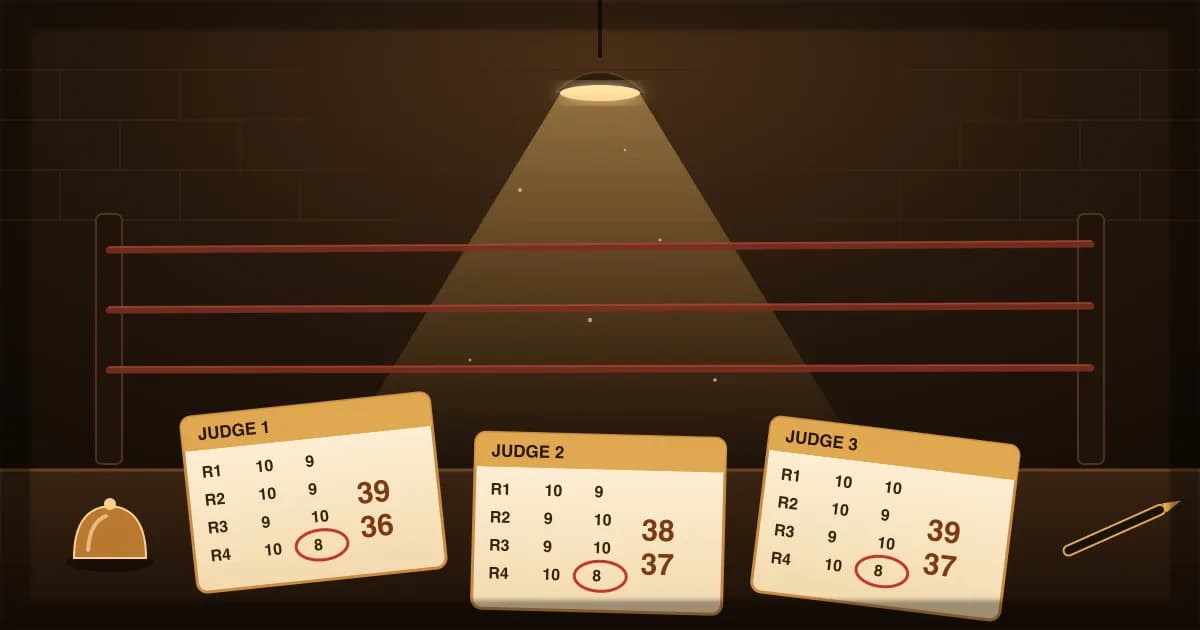
Boxing is scored on the 10-point must system: three judges each give the winner of every round 10 points and the loser 9 or fewer, then add up their own cards at the final bell. A knockdown usually costs the fallen boxer one extra point, the referee can take points away for fouls, and the boxer ahead on most of the three cards wins the decision.
That covers a professional fight under the Unified Rules most US commissions use. Below you get the exact scale judges work from, the four things they look for in a round, how knockdowns and fouls change the numbers, every decision name from unanimous to split draw, what happens when a fight stops early, and how amateur boxing scores with five judges instead of three. Score a fight yourself as you read with our boxing scorecard.
Score one round on the 10-point must system
Every judge scores every round on its own. The Association of Boxing Commissions (ABC) Boxing Judge Manual tells judges to treat each round as its own bout and never to keep a running score of the fight. The winner of the round must get 10. The loser gets 9 or fewer, depending on how clearly they lost.
| Round score | What the round looked like |
|---|---|
| 10-9 | One boxer won the round. Most rounds score this way. |
| 10-8 | One knockdown, or one boxer won in an extremely decisive way and hurt the other. |
| 10-7 | Two knockdowns, or one knockdown inside a round one boxer dominated. |
| 10-6 | More than two knockdowns. |
| 10-10 | No clear winner. The manual says this should rarely happen. |
The scale has a floor. The ABC Referee Guidelines say a round never goes below 10-6 unless the referee deducts points.
Close rounds still give a full point. The manual warns that a boxer who wins every round by the slimmest margin ends a 12-round fight at 120-108, and it tells judges never to hand a round to the other boxer just to make a card look closer.
Know the four things judges look for
The judge manual lists four factors. Treat them as a ladder: when two boxers sit close on the first, the next one breaks the tie.
- Clean and effective punching. Fights are won by clean, effective punches that land. Hard punches count, and so does the number of punches, and good body shots count as much as head shots.
- Effective aggressiveness. Coming forward only scores when it lands. A pressure fighter who keeps getting beaten to the punch by counters is not effectively aggressive.
- Ring generalship. The boxer who controls the action with footwork, feints and position, making the other boxer miss and then landing, wins this one. Running and simply avoiding action earns nothing.
- Defense. Punching while not getting punched: slipping, countering, fighting off the ropes. Holding and clinching to avoid contact does not count as defense.
Judges also split the target into zones. A punch to the head or to the body between the shoulders and the top of the hips scores. A punch that lands on the arms usually does not, unless it lands high on the shoulder. Learn the punches judges see most in our boxing punches guide.
When a round feels even, the manual tells judges to ask one question: which boxer controlled the round and forced most of the action?
Count a knockdown the way judges do
A knockdown usually turns a 10-9 round into a 10-8 round for the boxer who scored it. The judge does not decide whether it was a knockdown: when the referee rules a knockdown, the judge scores a knockdown.
The judge still scores the whole round. The ABC manual walks through three situations:
- You lead the round and score a knockdown: 10-8 for you.
- You lead the round narrowly and then go down: 10-8 for your opponent, because the knockdown outweighs your small lead.
- You get beaten up all round, then land a flash knockdown late: 10-9 for you. The manual calls a knockdown second best only to a knockout.
The same rules cut the other way. A boxer who drops the opponent early and then loses the rest of the round badly, and hurts nobody, can end up with only 10-9. A boxer who scores a knockdown and also dominates the rest of the round can take 10-7 with one knockdown.
You can also score 10-8 without a knockdown. The manual describes it: one boxer chases the other all round, lands clean power shots that stun, and the other boxer only survives, backing up and throwing a few insignificant punches.
A few more knockdown rules from the Unified Championship Rules the Nevada Athletic Commission publishes:
- Every knockdown gets a mandatory eight count.
- There is no standing eight count and no three-knockdown rule.
- The bell never saves a downed boxer, in any round.
- If both boxers go down together and stay down for the full count, the bout ends as a technical draw (ABC Referee Guidelines, section 17).
Take points away for fouls
Only the referee deducts points. The referee stops the action, tells the judges which boxer loses how many points, and each judge scores the round as normal and then writes the deduction beside the score. The judge manual tells judges not to let a deduction change how they score the round itself.
Under the Unified Rules, an intentional foul that causes an injury costs two points, and that deduction is mandatory. Other fouls can cost a point at the referee's discretion.
Here is how a deduction lands on a card. You win round 6 clearly, 10-9, but the referee takes a point from you for repeated holding. Your round now reads 9-9. Take two points for an intentional headbutt that cuts your opponent and the same round reads 8-9: you won it and still lose ground.
Add up the cards and name the decision
When the fight goes the distance, each judge adds every round on their own card. The boxer with the higher total wins that card. The bout goes to the boxer most cards favor, and the way the three cards split gives the decision its name.
| How the three cards read | Decision |
|---|---|
| All three for the same boxer | Unanimous decision |
| Two for one boxer, one for the other | Split decision |
| Two for one boxer, one level | Majority decision |
| Two level, one for either boxer | Majority draw |
| One for each boxer, one level | Split draw |
| All three level | Unanimous draw |
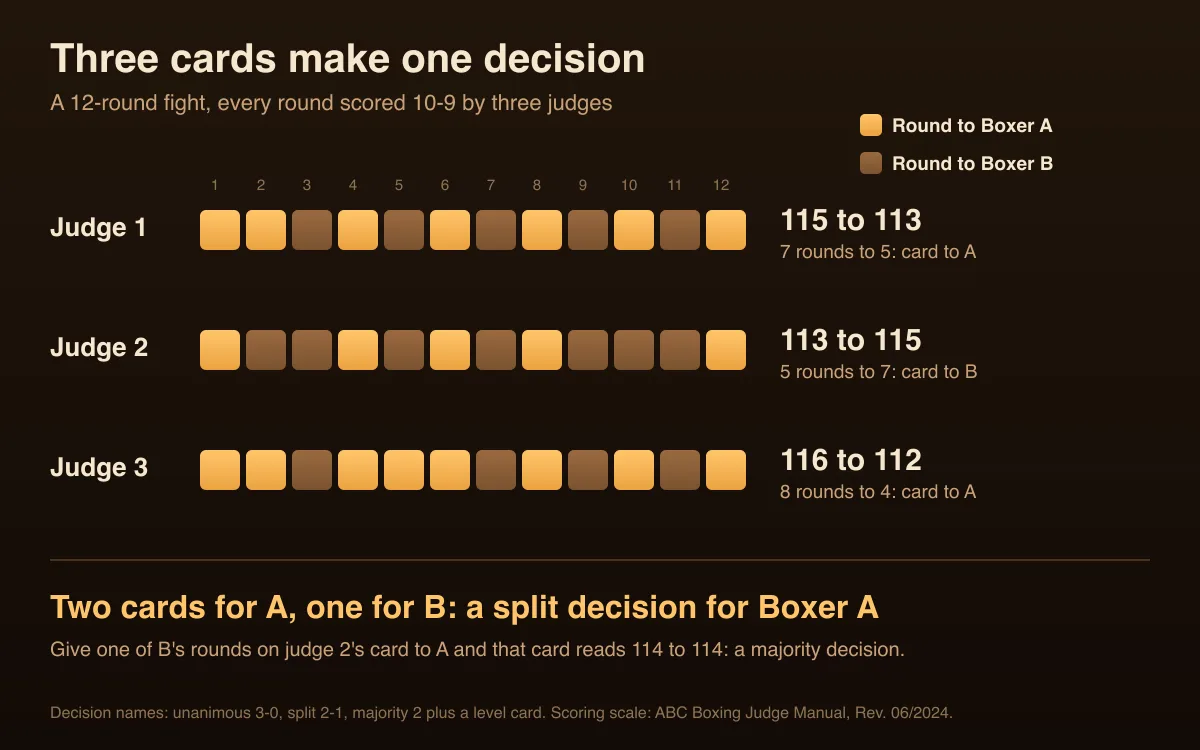
Work through a 12-round example. Judge 1 gives Boxer A seven rounds to five, all at 10-9: 115-113 for A. Judge 2 sees the same fight five rounds to seven: 115-113 for B. Judge 3 gives A eight rounds to four: 116-112 for A. Two cards for A and one for B make a split decision for A.
Now give one of B's rounds on judge 2's card to A instead. That card reads 114-114, so two cards favor A and one sits level: a majority decision. One round on one card changed the name of the result.
A total also tells you less than it seems. On a 12-round card, 115-112 can mean 7 rounds to 5 with one 10-8 round for the winner, or 8 rounds to 4 with one 10-8 round for the loser. Read the round boxes before you trust the total.
Know what happens when a fight stops early
A knockout or a stoppage by legal punches ends the fight without the cards. A boxer hurt by a legal punch who cannot go on loses by TKO.
The cards come back when a foul or an accident stops the fight. The ABC Referee Guidelines set the four-round rule in section 34:
- An accidental foul or injury stops the bout before four full rounds: no decision.
- An accidental foul or injury stops it after four full rounds: a technical decision for the boxer ahead on the cards, and the judges score the partial round.
- An intentional foul's injury stops it immediately: the fouling boxer is disqualified.
- An intentional foul's injury forces a stoppage in a later round: the fouled boxer wins a technical decision if ahead on the cards, and the bout is a technical draw if that boxer is even or behind (Unified Championship Rules 13.A.2).
Four rounds count as complete when the bell ends the fourth round. A boxer hit with an accidental low blow gets up to five minutes to recover and continue, or loses the fight.
Score an amateur bout under World Boxing rules
Olympic-style boxing uses the same 10-point idea with different numbers. The World Boxing Competition Rules in force since November 2024 set three rounds of three minutes with a one-minute rest (rules 1.1.5 and 1.1.7) and five judges who score every round while the referee scores nothing (rule 6.1.1).
The criteria come in a fixed order (rule 7.2.1):
- The number of scoring blows. A blow scores when it lands cleanly on the target with the knuckle part of the glove, with body or shoulder weight behind it, without breaking a rule, and the judge sees it clearly. When the counts sit close, the quality of the blows decides.
- Technical and tactical superiority. Control of the round, effective aggression, setting the pace, neutralizing the other boxer's style, making them miss.
- Competitiveness. Initiative and a clear intention to win, used only when everything else sits even.
The allocation changes too (rules 7.3 and 7.4). A close round scores 10-9, a clear winner 10-8 and total dominance 10-7, and a knockdown or a standing eight count can sit inside any of the three. Seven is the lowest losing score, every round needs a winner, and a 10-10 round does not exist.
Warnings replace deductions. Each warning takes one point off the offending boxer's total on every judge's card (rule 8.11.4), and a third warning disqualifies the boxer (rule 8.11.2).
With five cards, the winner needs three. Five of five is a unanimous decision, and 4-1 or 3-2 is a split decision (rules 9.1.2 and 9.1.3). A judge with level totals must name a winner when the other cards leave the bout undecided (rule 9.1.4), so an amateur bout on points never ends in a draw.
World Boxing keeps testing more objective scoring. Its summary of the 2024 rule changes describes a trial system built only on counted blows: 10-9 for a gap of fewer than 6 scoring blows, 10-8 for 6 to 11 and 10-7 for 12 or more. Its 2025 amendment bundle proposes bout challenges reviewed with AI bout analysis, where overturning a result would need a gap of at least three scoring blows.
See why judges disagree
Judges watch the same three minutes from different seats, and research shows the seat and the crowd matter.
- Home advantage grows with the judges' role. Balmer, Nevill and Lane studied European championship bouts and found that for two evenly matched boxers, the home boxer's chance of winning rose from 0.57 in fights that ended by knockout to 0.74 in fights decided on points. Across a century of Olympic Games, Balmer and colleagues found strong home advantage in judged events such as boxing and little or none in measured events such as weightlifting.
- Crowd noise moves scores. In a live international Thai boxing tournament, Myers and Balmer put some judges in noise-canceling headphones. Crowd noise shifted scoring by just over half a point per five-round bout under the same 10-point must system.
- Most scoring blows are hard to separate. Elite amateur boxers throw about 20 punches a minute, by Davis and colleagues' video analysis of Olympic finals and semifinals. Winners landed more punches in round 3, yet the authors wrote that the outcome may depend on which punches the judges happen to score. A follow-up after the 2013 rule changes found winners threw more straight punches and landed more of them as the bout went on.
- Even the ropes get in the way. When Uca and colleagues had certified judges score bouts in a ring with transparent ropes, their scores came out more consistent across every zone of the ring.
The lesson for a boxer: win rounds clearly. A round you win by one clean punch can go either way on a card. Read our sparring tips for beginners to build the clean, scoring shots that leave judges no doubt.
Fix the mistakes fans make when they score a fight
Score the next fight you watch on a card and check yourself against these.
- You keep a running total. Score each round as its own fight and forget the last one. A boxer down 0-6 can still win round 7 10-9.
- You score the last 30 seconds. A late flurry counts the same as a punch in the first minute. The judge manual warns against letting a boxer steal a round at the bell.
- You reward walking forward. Pressure only scores when it lands. Ask who landed the cleaner punches first.
- You count arm punches. Shots that land on the gloves and forearms rarely score. Watch whether the punch reached the head or the body.
- You give every knockdown an automatic 10-8. Score the whole round. A knockdown inside a round the other boxer dominated can still come out 10-9.
- You let blood decide. A cut does not mean a boxer is losing the round. Judges must ignore blood and swelling and score the punches.
- You score the name. When the bell rings, both boxers start equal. The manual says a championship is earned, never given.
Get quick answers
How many judges score a boxing match?
Three judges score a professional bout under the ABC Referee Guidelines, each on a separate card. World Boxing amateur bouts use five judges, and the referee does not score.
What does 10-9 mean in boxing?
The boxer with 10 won the round and the boxer with 9 lost it. Most professional rounds score 10-9, so a 12-round card of 116-112 usually means 8 rounds to 4.
Can a boxing round be scored 10-10?
In professional boxing, yes, but the ABC Judge Manual says it should rarely happen. In World Boxing amateur bouts, no: every round needs a winner.
What is the difference between a split decision and a majority decision?
In a split decision two judges pick one boxer and the third judge picks the other. In a majority decision two judges pick one boxer and the third card is level.
Does a knockdown always make a round 10-8?
No. A knockdown usually adds one point to the margin, but judges score the whole round. A boxer who scores a knockdown and loses the rest of the round badly can end up 10-9 either way.
How long is a round in boxing?
Professional rounds run three minutes with a one-minute rest, and championship fights go 10 or 12 rounds. World Boxing bouts run three rounds of three minutes. See how many rounds each kind of fight runs and the boxing weight classes that decide who fights whom.
Check the sources
- Association of Boxing Commissions and Combative Sports, Boxing Judge Manual, Rev. 06/2024
- Association of Boxing Commissions, Referee Guidelines
- Nevada Athletic Commission, Unified Championship Rules
- World Boxing Competition Rules, in force November 2024
- World Boxing, Summary of Competition Rule Changes, October 2024
- World Boxing, Proposed Bundle of Amendments to the Competition Rules, 2025
- Balmer, Nevill and Lane, Do judges enhance home advantage in European championship boxing? Journal of Sports Sciences, 2005
- Balmer, Nevill and Williams, Modelling home advantage in the Summer Olympic Games, Journal of Sports Sciences, 2003
- Myers and Balmer, The impact of crowd noise on officiating in Muay Thai, Frontiers in Psychology, 2012
- Davis, Benson, Pitty and colleagues, The activity profile of elite male amateur boxing, International Journal of Sports Physiology and Performance, 2015
- Davis, Connorton, Driver and colleagues, The activity profile of elite male amateur boxing after the 2013 rule changes, Journal of Strength and Conditioning Research, 2018
- Uca, Ayvaz, Yildiz and colleagues, Ergonomic solutions for referee mistakes in boxing competitions, Perceptual and Motor Skills, 2026