
Technique
How to Throw a Cross Punch Properly, Foot to Fist
Throw a cross that lands hard and comes back fast: 6 steps from the back foot to the fist, numbers from punch studies, the 1-2, 6 fixes and 3 drills.
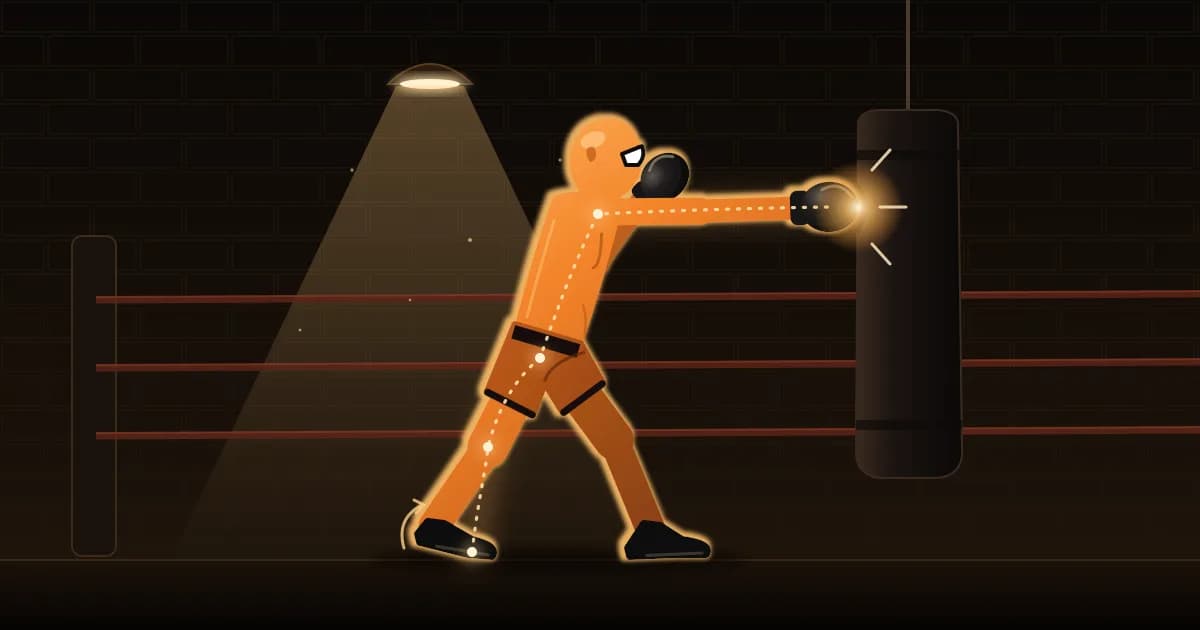
Throw a cross by pushing off your back foot, turning your rear heel out and your hips and shoulders toward the target, and driving your rear hand straight from your chin to the target with the palm turned down. Keep your lead glove at your face and your chin behind your rear shoulder, then bring the hand back along the same line to your cheek.
The cross is punch number 2, the rear-hand straight: your right hand if you box orthodox, your left if you box southpaw. Below you get the six steps from the floor to the fist, what force plates and motion capture show about where the power comes from, how to land it behind the jab, the six mistakes that rob it, and three drills for this week. If you are new to the punch numbers, start with our boxing punches guide.
See where the cross gets its power
The cross hits harder than the jab because your whole body travels further behind it. In a 2026 motion-capture study, Wan and Liu measured 17 elite orthodox boxers throwing both straight punches at full effort. Compared with their jab, the cross showed:
| What they measured | Jab (lead hand) | Cross (rear hand) |
|---|---|---|
| Trunk rotation | 43 degrees | 73 degrees |
| Peak rear-leg push on the floor | 734 N | 1,132 N |
| Peak fist speed | 6.76 m/s | 7.75 m/s |
| Peak force on the target | 1,244 N | 1,556 N |
| Time from start to finish | 0.44 s | 0.67 s |
Read the table from top to bottom and you have the whole technique. Your trunk turns about 30 degrees further, your back leg pushes about 50% harder into the floor, and the punch lands about 25% harder. The price is time: the cross took a fifth of a second longer than the jab, which is why you set it up instead of throwing it cold.
Other labs found the same gap. Smith and colleagues measured maximal straight punches on a boxing dynamometer: 4,800 N with the rear hand against 2,847 N with the lead hand in elite boxers, and the rear hand won in every group from novice to elite. When Xu, Sun and Zhu compared rear straight punches across combat sports, boxers hit hardest of every group, at 3.96 times their body weight.
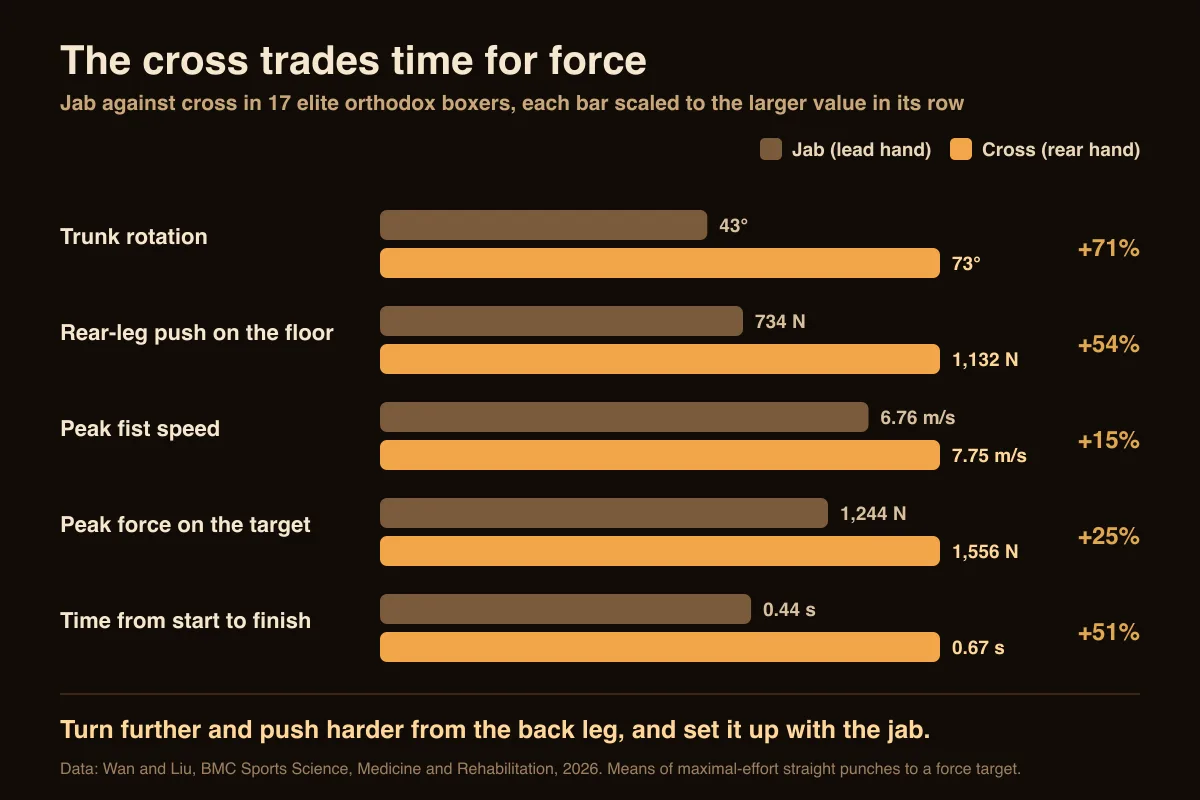
Lead against rear straight punch in 17 elite orthodox boxers. Data: Wan and Liu, BMC Sports Science, Medicine and Rehabilitation, 2026.
Work out your own number
Take a 70 kg boxer. Body weight is 70 × 9.81, about 687 N. At the 3.96 times body weight Xu's boxers reached, that boxer's cross would land with about 2,720 N. The elite boxers in Wan and Liu's study weighed 66 kg on average, about 648 N, so their back leg pushed with roughly 1.7 times body weight in the cross and 1.1 times in the jab. Your number will sit lower while you learn. What matters is the direction: more push from the back leg, more turn through the trunk.
Throw the cross in six steps
Learn the cross slowly in front of a mirror first. Every step below happens in about two thirds of a second at full speed, so you need each one automatic before you add power.
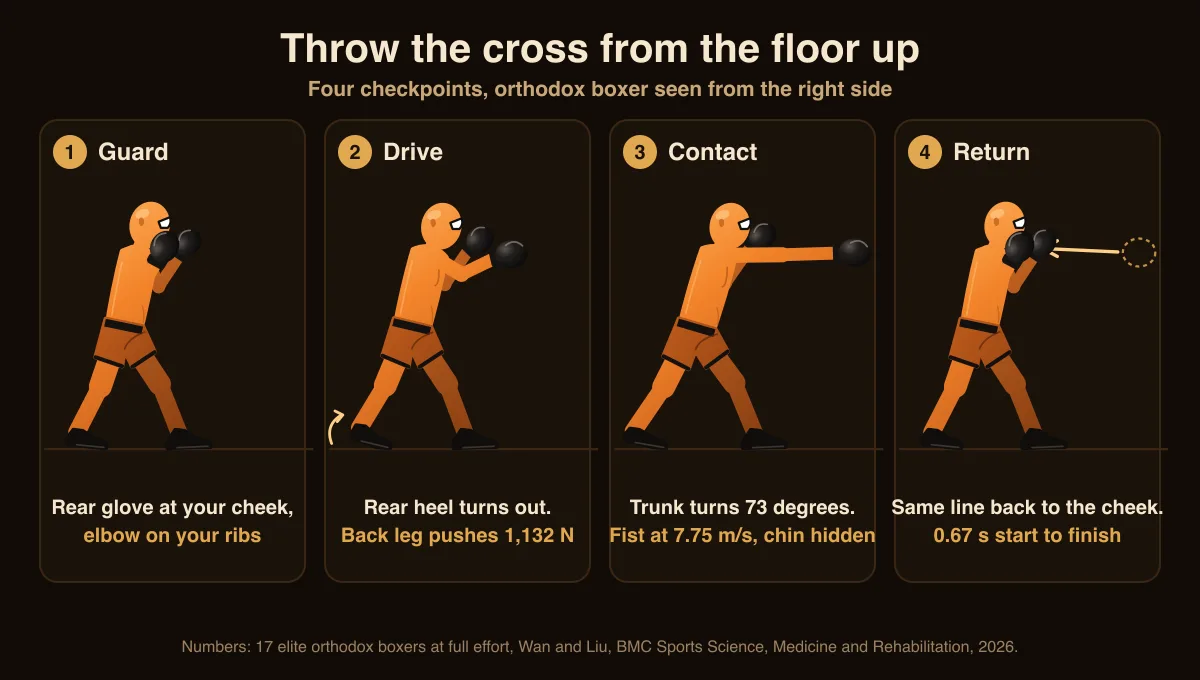
1. Set your stance and your rear glove
Stand in your normal stance with your feet about shoulder width apart, your lead foot forward and your rear heel slightly raised. Rest your rear glove against your cheek or jaw with the elbow close to your ribs. That glove position is the start and the finish of every cross you throw. Fix your base first if your feet sit in a line or too wide.
2. Push off the back foot
Press the ball of your rear foot into the floor and turn the heel outward, as if you were crushing a bug under it. Your rear knee turns in with it. This is where the cross starts: in Wan and Liu's data, the rear leg's push rose from 734 N in the jab to 1,132 N in the cross, and most of it came from the leg straightening and pushing up against the floor.
3. Turn your hips, then your shoulders
Let the leg drive turn your rear hip toward the target, and let your shoulders follow a split second later. Your rear shoulder travels forward toward the target. The elite boxers turned their trunk 73 degrees in the cross, about 70% more than the 43 degrees of the jab.
4. Drive the fist on a straight line
Send the rear glove straight from your chin to the target, the shortest line between the two. Keep the elbow behind the glove and turn your palm down in the last third of the punch so the knuckle part of the glove lands. Rules care about that: the Nevada Rules of Unarmed Combat (rule 4.120) define a fair blow as one landed with the padded knuckle part of the glove, and the World Boxing Competition Rules count a scoring blow only when it lands with the knuckle surface (rule 7.2.2).
5. Protect your chin at full reach
At full extension, your rear shoulder rises to cover your chin, your lead glove stays at your face and your eyes stay on the target. Your head stays inside your stance, roughly over your lead knee and no further. If you have to lean past your front foot to touch the target, you stood too far away.
6. Return on the same line
Bring the glove back to your cheek along the path it took out, as fast as it went. Your rear heel turns back, your hips square to your stance and you are ready to throw again or defend. A cross you leave out is a cross your opponent counters with a lead hook.
Use your body mass, then your arm speed
Here is the finding that changes how you practice. Dinu and Louis compared elite and junior boxers and found the same fist speed in the cross, 8.1 m/s in both groups. The elite boxers still hit with 3,158 N against 1,021 N for the juniors. Speed alone cannot explain that gap, which points to more body mass behind the same hand speed.
Two more numbers point the same way. When Walilko, Viano and Bir had Olympic boxers throw straight punches at a crash-test dummy's jaw, the punches averaged 3,427 N at 9.14 m/s, and boxers from heavier classes hit harder mainly because they put more effective mass behind the punch. And when Nakano and colleagues measured expert boxers' rear straight punches into a target about as heavy as a head, the punching arm delivered about 95% of the impact: 40% from the upper arm, 35% from the forearm and 20% from the fist and glove.
Put those together and you get three cues:
- Drive from the floor. The leg push and the trunk turn put mass behind the arm.
- Keep the arm a firm unit at contact. A relaxed arm on the way out and a firm fist, wrist and elbow at impact let the upper arm and forearm pass their momentum into the target.
- Hit through the target. Aim a few centimeters behind the surface so the arm is still moving at full speed when it lands.
The force also moves forward under you. At the cross, Dinu and Louis found elite boxers carried about 61% of their ground force on the front foot and 39% on the back foot. Your weight travels toward the lead leg as you punch and stays over your base.
Land it behind the jab
The jab is the cross's best friend. It measures the distance, it makes your opponent raise a guard or blink, and it hides the fifth of a second the cross needs. Throw the 1-2 like this:
- Jab from your stance and keep your rear glove at your cheek.
- Start the rear-foot turn as the jab begins to come back.
- Fire the cross down the line the jab just opened while your lead glove returns to your face.
- Return the cross to your cheek and move or throw again.
Practice the 1-2 at the distance where your jab lands at full reach. If the cross falls short, take a small step in with the jab. If it jams, take a small step out. Our jab technique guide covers the lead hand, and the boxing combinations for beginners show where the cross goes next: the 1-2-3 adds a lead hook off the rear hand's return.
Fix the six mistakes that rob your cross
Film from the side and from 45 degrees in front and check one mistake at a time.
- You pull the hand back before you throw. The glove dips or cocks behind your head and your opponent sees it coming. Fix: hold your guard for one count between reps and start every cross from the cheek. Our punching mistakes guide has a full correction ladder for this one.
- Your rear heel stays flat. The arm does all the work and the punch feels like a push. Fix: throw ten slow crosses where you only think about turning the heel out, then add speed.
- Your lead hand drops as the cross goes out. You leave the side of your head open to a right hand or a hook. Fix: press your lead glove to your forehead for a full round of crosses, then relax it back to the normal guard.
- You lean past your front knee. You overreach, lose balance and land in range of the counter. Fix: put a mark on the floor in front of your lead foot and keep your head behind it at full reach.
- The punch loops wide. The elbow flares and the glove swings around the guard. Fix: throw along a strip of tape on a mirror or a door frame, glove on the line out and on the line back.
- You slam the elbow straight. Snapping into a locked joint on a miss can strain the elbow. Fix: stop the arm just short of full lock in shadowboxing and let the bag stop it on bag rounds.
Drill the cross three ways this week
Run these three drills on three different days. Set a round timer to 2 or 3 minutes with 1 minute rest.
- Freeze at full reach (2 rounds). Shadowbox single crosses at half speed and hold every one at full extension for two seconds. Check four points in a mirror: rear heel turned out, hips facing the target, rear shoulder at your chin, lead glove at your face. Then return on the same line.
- Line drill (2 rounds). Stand side-on to a mirror with tape running from your chin height to a target mark. Throw crosses that stay on the tape out and back. Count the reps where the glove leaves the line and aim for zero.
- 1-2 on the bag (3 rounds). Throw the 1-2 on a heavy bag at 70% effort for round one, 80% for round two and 90% for round three. Film round three from the side and check your return to guard after every cross.
Keep the effort controlled while the movement is new. Power comes from the six steps working together, and those take hundreds of clean reps.
Protect your hands while you build power
The cross is the punch most likely to land at full force, so it is also the one most likely to hurt your hand. In the Great Britain Olympic squad, Loosemore and colleagues found that hand and wrist injuries happened about as often in competition as in training, despite far fewer competition hours, and the most common diagnoses were knuckle sprains ("boxer's knuckle") and instability where the hand bones meet the wrist. Stewart and colleagues found the cross produced the highest punch force of six punches, 1,475 N in amateur boxers, and the cross and the left hook lost the most force once their legs were tired.
- Wrap your hands for every bag and pad session. Follow our hand wrapping guide.
- Keep your fist, wrist and forearm in one straight line at contact. A bent wrist on a hard cross is how hand injuries start.
- Build power over weeks. Add effort only when the six steps stay clean on video.
- Stop and see a physician if a knuckle swells, a wrist hurts when you grip, or pain lasts into the next day. Spar only under a qualified coach.
Get quick answers
What is a cross in boxing?
The cross is the rear-hand straight punch, number 2 in the punch numbers. An orthodox boxer throws it with the right hand and a southpaw with the left. It travels in a straight line from the chin to the target.
Why is it called a cross?
The rear hand travels across your body to reach a target in front of your lead shoulder, crossing the line of your stance. Some coaches simply call it the straight right or the 2.
Is a cross the same as a straight right?
For an orthodox boxer, yes. For a southpaw, the cross is the straight left. Both names describe the rear-hand straight punch.
Should my rear foot pivot when I throw a cross?
Yes. Turn your rear heel outward on the ball of the foot so your hip can turn. In elite boxers, the back leg pushed about 50% harder in the cross than in the jab.
Why is my cross weaker than my jab?
Usually your rear heel stays flat or you push with the shoulder alone. Elite boxers in one study had the same fist speed as juniors and three times the force, because they put more body mass behind the punch.
Check the sources
- Wan and Liu, Kinematic and kinetic differences between lead and rear straight punches in elite boxers, BMC Sports Science, Medicine and Rehabilitation, 2026
- Dinu and Louis, Biomechanical analysis of the cross, hook and uppercut in junior vs. elite boxers, Frontiers in Sports and Active Living, 2020
- Smith, Dyson, Hale and Janaway, Development of a boxing dynamometer and its punch force discrimination efficacy, Journal of Sports Sciences, 2000
- Walilko, Viano and Bir, Biomechanics of the head for Olympic boxer punches to the face, British Journal of Sports Medicine, 2005
- Nakano, Iino, Imura and Kojima, Transfer of momentum from different arm segments to a light movable target during a straight punch thrown by expert boxers, Journal of Sports Sciences, 2014
- Xu, Sun and Zhu, Analysis of the impact force and key technique of backward straight punch in different combat sports, Scientific Reports, 2025
- Stewart, Cornett, Baker and colleagues, The role of lower limb kinetics in boxing punches and the impact of fatigue, Bioengineering, 2025
- Loosemore, Lightfoot, Gatt, Hayton and Beardsley, Hand and wrist injuries in elite boxing, Hand, 2017
- Nevada Athletic Commission, Nevada Rules of Unarmed Combat, revised November 2024
- World Boxing Competition Rules, in force November 2024